Who are our children? They are the most important and integral part, most often, of our interest in acquiring knowledge to enhance their development. So, our observations and primary focus as caregivers, be it parent(s) or as education professionals often start in the home. Parents are a child’s first and foremost teachers and teachers, both home and at school, are also constantly attempting to disentangle the child’s best manner of learning and the enabling of development to their maximum potential. Here in my blog, we will look at child development through the eyes of conscientious partners in childhood development. Children are one of the most important and integral parts of our interest in acquiring our own knowledge in the pursuit of their advancement. Be you a parent or a professional educator, knowledge and understanding about the methods and proclivities our young pass through on the way to adulthood and maturity both mental and physical is of critical importance. Our observations and primary focus as caregivers, be it parental or as a professional educator, often starts at home. Parents are a child’s first and foremost teachers and teachers at school also constantly attempt to disentangle the child’s best manner of learning and developing to their maximum potential. Here in this blog, we will look at child development as conscientious partners in childhood development while also studying and learning about multiple theories that will attempt to personalize meaningful learning experiences that highlight cognitive and language development.
This blog will attempt to explain the theories of four classical theorists, Jean Piaget, Erik Erickson, Kohlberg and Lev Vygotsky, and what they have contributed to developing skills in assessment and advancing early childhood and adolescent cognitive development with a concentration of development of language skills written and oral.
Jean Piaget was a Swiss psychologist considered at the forefront of the development of educational psychology and generally considered the “Father of Educational Psychology”. He was also a father and took enormous interest in studying his own children thereby arriving at some of the very first modern theories regarding educational psychology. The chart below illustrates the four stages in a child’s cognitive development he developed and are still currently accepted today.
| Stage | Age | Characteristics | Goal |
| Sensorimotor | Birth to 18–24 months old | Motor activity without use of symbols. All things learned are based on experiences, or trial and error. | Object permanence |
| Preoperational | 2 to 7 years old | Development of language, memory, and imagination. Intelligence is both egocentric and intuitive. | Symbolic thought |
| Concrete operational | 7 to 11 years old | More logical and methodical manipulation of symbols. Less egocentric, and more aware of the outside world and events. | Operational thought |
| Formal operational | Adolescence to adulthood | Use of symbols to relate to abstract concepts. Able to make hypotheses and grasp abstract concepts and relationships. | Abstract concepts |
It must be recognized that Piaget’s research would not be considered empirical since his study group consisted of his own children. The age ranges for a child’s movement through these stages are not absolute as onset in age will vary and there is almost invariably a great deal of overlap. In examining where any specific child lies upon the above graphic one must consider the four specific features of educational development which are language, morals, memory, and reasoning. We recognize that a child’s learning capability and capacity is internal thus all knowledge is developed only through personal experience and that learning is an inherent trait so will occur without resort to parents, teachers, peers, or older children. For this reason, rewards are not really required to motivate any child into learning. The previous forms the basis for Piaget’s assumptions regarding this subject. (Marcin & Gill, 2018) A summary in the form of a chart can be accessed through the Piaget Stages Link on our home page
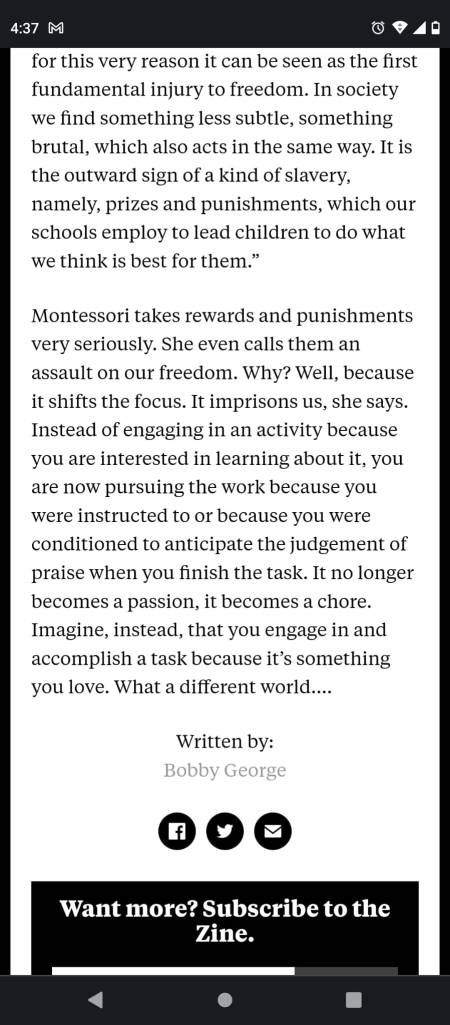
Here also Maria Montessori promotes from her Montessori method she describes this reward/ punishment concept as the downfall of education. Bobby George sums it up best in her blog as
Lev Vygotsky theorized that social interaction is a critical component of learning. Cognition is the result of learning; he created the concept of a Zone of Proximal Development (ZPD). The zone itself is defined as the difference between what a student knows and what is desired to be learned. The student relies on individuals that they themselves perceive as having the desired knowledge. This indicates that parent(s) and older siblings are the initial targets of knowledge and, as the child ages, this zone increases in size and availability. This is where areas such as language, morals, culture, tradition, and so on have great impact. The student must be in a receptive state. Recognition and promotion of that state is often the key to the education of our students and children. “Vygotsky’s primary contribution was in developing a general approach that brought education, as a fundamental human activity, fully into a theory of psychological development. Human pedagogy in all its forms, is the defining characteristic of his approach, the central concept in his system.” (Luis C. Moll, p. 15 Vygotsky and Education) “The Vygotskian perspective and dynamic assessment have profound implications for diagnosis and instruction.” Lisbeth Dixon-Krauss, Vygotsky in the classroom, p. 148
A visual of Vygotsky’s Zone of Proximal Development can be accessed here or from the link on the home page.
Lawrence Kohlberg a renowned American psychologist also developed theories on the stages of development. His are self-explanatory through the graphic on this link.
Resources
Dixon-Kraus, L. (1996). Vygotsky in the classroom: Mediated literacy instruction and assessment. Longman Publishers, USA. ISBN: 0-8013-1590-5
George, B. (ND). Rewards and punishments: Thoughts & reflections. Baan Dek. https://baandek.org/posts/rewards-and-punishments.
Haggbloom SJ, Warnick JE, Jones VK, et al. The 100 most eminent psychologists of the 20th century. Rev Gen Psychol. 2002;6(2):139–152. doi:10.1037/1089-2680.6.2.139
Marin, G., and Gill, K. (2018). What Are Piaget’s Stages of Development and How Are They Used? Healthline. https://www.healthline.com/health/piaget-stages-of-development.
Moll, L. (Ed.). (1990). Vygotsky and education: Instructional implications and applications of sociohistorical psychology. Press Syndicate of the University of Cambridge. ISBN: 0-521-38579-2 Wayne, A (Ed.). (2014). Rethinking education: Teaching for racial and cultural justice, 2nd Edition. A Rethinking Schools Publication. ISBN: 978-0-942961-53-9
 ConUCo Educativo
Leave a comment